

Amy Geisberger, Head of Sustainability
An Interview with Amy Geisberger, Head of Sustainability at Siemens Canada
In this month’s cover story, we sit down with Amy Geisberger, the Head of Sustainability for Siemens Canada, to discuss the organization’s ambitious roadmap to decarbonization including internal operational shifts and innovative public sector partnerships. Guided by the Siemens globally aligned DEGREE framework, the organization prioritizes physical decarbonization and electrification. Head of Sustainability Amy Geisberger outlines how the company leverages microgrid technology, building automation, and advanced software to modernize infrastructure in campuses, schools, hospitals and more. Beyond technical upgrades, the company addresses financial barriers through specialized funding models and fosters environmental literacy via experiential learning initiatives like the "Net Zero Classroom” Ultimately, Siemens aims to act as a top- down leader in the green transition, helping clients significantly reduce their carbon footprints by 2030 and beyond.
A Personal Mission for Global Impact
Amy Geisberger’s path to sustainability was not a straight line. With a background in business and marketing in the music industry, she eventually realized her passion for environmental protection, a value rooted in her upbringing on a farm. After pursuing a Master’s Degree in Sustainability Management at the University of Toronto and working for the UN Global Compact and Competent Boards, she joined Siemens, attracted by their commitment to driving sustainability from the boardroom to the ground floor. "I’m so much more passionate about this type of work now that I’ve got two kids," Geisberger shared, highlighting how the work has become even more meaningful.
Award Winning Team of Experts
Siemens plays a multifaceted role in the transition to Net Zero for public sector facilities, including hospitals, K-12 schools, and higher education institutions. They employ a diverse team of experts, such as energy engineers and building automation specialists, leveraging cutting-edge technologies like smart building software and grid edge technology to modernize and future-proof infrastructure. Siemens collaborates with third-party organizations to integrate comprehensive solutions tailored to the specific needs of each project, ensuring effective execution. By implementing energy efficiency, electrification, and on-site renewable energy solutions, such as solar panels and battery storage, they help facilities achieve their sustainability goals. Overall, Siemens is committed to helping public sector facilities significantly reduce their carbon footprints, demonstrating a long-term dedication to sustainability and aligning with broader climate goals. So much so that they have been recognized as a Climate Change A-lister with a recent, EcoVadis Platinum medal in 2025.
The following outlines a few of Seimens’ areas of expertise per Geisberger.

Scope 1 & 2 Emissions
Siemens has set a firm goal to reach Net Zero in Scope 1 and 2 emissions by 2030. A central tenet of this plan is a focus on physical reduction rather than purchasing carbon credits, as the company sees a better return on investment through efficiency and electrification. They anticipate only using offsets for the final 10% of emissions that cannot be physically eliminated, and only if necessary.
In Canada, the current focus for Siemens is on decarbonizing their factories. The company's Drummondville facility, which produces electrical products for Canadian and international markets, is currently their highest emitter due to aging building assets, gas heating, and their gas-powered drying oven on its paint line. Siemens is utilizing its own internal team—made up of energy engineers and building and decarbonization experts—to enable efficiencies and electrify these processes.
Supply Chain (Scope 3)
The company’s ambition for its supply chain is to reach Net Zero by 2050. This is considered a more difficult challenge, requiring one-on-one conversations with suppliers. Geisberger mentioned that they are moving beyond simply asking if suppliers have Net Zero goals; they are now tracking data more closely and asking specific questions to drive behavioral changes and help suppliers realize what is possible.

Renewables and Microgrids
Siemens integrates renewables through the use of microgrid controllers, which manage decentralized energy sources like solar and batteries. These systems allow buildings to interact intelligently with the grid, determining when to store power and when to use it for purposes like peak shaving to save costs.
Microgrids and Education: Siemens has partnered with BCIT and Humber Polytechnic. to create microgrid labs and credentials. At Humber, a microgrid integrates solar energy, EV chargers, and battery storage for educational purposes as part of micro credentials for student experiential learning.
Another example of their technology is the "Smartflower” a third-party solar-tracking system with a built-in battery and Siemens microgrid controller. While it acts as an "experiential learning piece" rather than a high-volume power producer, it is used in the Net Zero classroom initiative to educate students on how renewable energy interacts with the power grid in Saskatoon and PEI schools all part of integrating climate change into the curriculum.
The Power of Recommissioning: A recent project at the University of Toronto Scarborough (UTSC) demonstrated that massive gains can be made without new equipment. By optimizing how a key heat recovery unit was operating, adjusting temperature and waterloop settings, and updating day-to-day HVAC schedules in the science and chemistry building, Siemens helped UTSC achieve a 33% reduction in gas usage and reduce over 1,000 tons of CO2e annually.

Grid Software Group
The Grid Software Group works directly with grid operators to:
Plan for demand: Helping operators understand where and when energy needs will increase.
Decentralized Energy: Advising on when it makes sense to bring decentralized energy systems online to reduce stress on the main grid and avoid the use of fossil fuel-based generation.
Efficiency: Using software to make the grid more efficient and resilient against potential brownouts.
Backing Strategy with Global Investment
Siemens supports its ambitious strategies with significant financial backing, exemplified by a $6.6 billion Euro global investment in R&D last year, much of which focused on efficiency and sustainability. Rather than relying on high-level goals, the company showcases real-world projects executed globally to demonstrate how this capital is converted into physical decarbonization. By proving the efficacy of their internal "turnkey" teams and technologies, Siemens aims to lead by example, showing stakeholders that their strategy is matched by tangible investment and measurable results.

The "Backbone of Society": Driving Global Decarbonization
Siemens is working to transform the "backbone of society," says Geisberger, providing solutions for critical infrastructure required for electrical systems, industry, transportation, and buildings. This unique position allows the company to influence broader societal sustainability by developing products that improve efficiency at scale. While Siemens works to reduce its own internal footprint, its "handprint"—the impact its technologies have on customers—is even more substantial. A central goal of the DEGREE framework is to help customers avoid 1,000 megatons of CO2e emissions between 2023 and 2030 through the use of Siemens products and services. “This ambitious target exceeds the carbon footprint of many entire countries, illustrating the company's role in driving emissions reduction and the global energy transition”, per Geisberger.
Evolving with the Global Landscape
As international standards like the EU taxonomy and the expectations of ratings organizations continue to raise the bar for corporate responsibility, Siemens remains committed to transparent reporting and continuous improvement. The organization is proactively aligning its business model with these evolving global and Canadian reporting landscapes. This commitment ensures that Siemens is not merely reacting to market changes but is actively pushing the boundaries of what is possible in a Net Zero future. As Geisberger concludes, the company’s direction is clear: "We see that that’s where the world is going, and we can help make net zero possible."
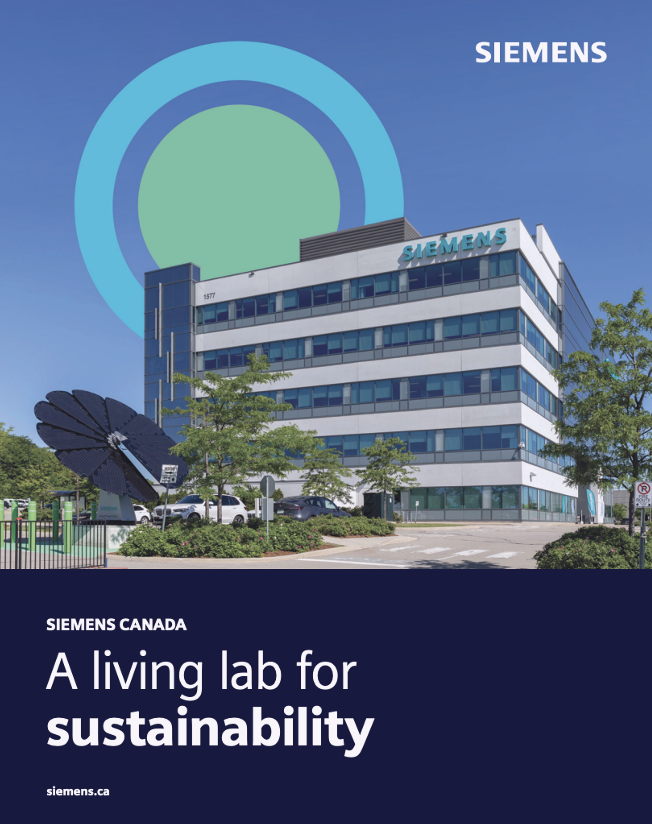
About Siemens Canada : Siemens Canada is a leading technology company focused on industry, infrastructure, mobility and healthcare. The company’s purpose is to create technology with purpose, transforming the everyday, for everyone, since 1912 in Canada. By combining the real and the digital worlds, Siemens empowers customers to accelerate their digital and sustainability transformations, making factories more efficient, cities more liveable, and transportation more sustainable. A leader in industrial AI, Siemens leverages its deep domain know-how to apply AI – including generative AI – to real-world applications, making AI accessible and impactful for customers across diverse industries. For everyone. Everywhere. Sustainably. In fiscal 2025, which ended September 30, 2025, Siemens Canada generated revenues of approx. $2.3 billion CAD. The company has approximately 4,600 employees from coast-to-coast and 38 office and production facilities across Canada. Further information is available at www.siemens.ca
Additional information for your interest:
For more information, contact: Amy Geisberger at amy.geisberger@siemens.com or 416-873-3152